



/
Join us as we explore the lives and times of some of history’s most prominent women of Asian and Asian American descent.
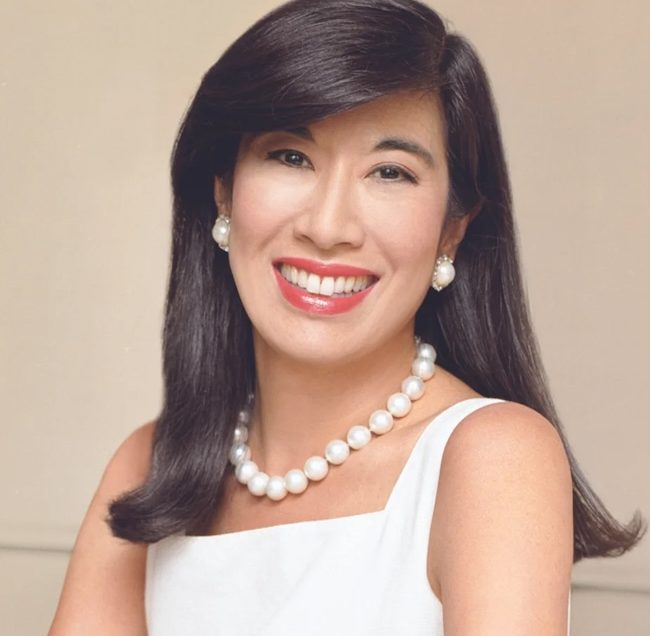
Andrea Jung is a case study in heart-led leadership delivering shareholder value and growth.
INTRO:
“Fire yourself on a Friday night and come in on Monday morning as if a search firm put you there as a turn-around leader. Can you be objective and make the bold change?”
This is a quote from business leader and CEO Andrea Jung, a Chinese Canadian American who climbed the ranks of upscale retail to find herself at the helm of an ailing Avon brand in the 1990’s. She is one of the first women to serve as a CEO of a Fortune 500 company as well as one of the longest serving female CEOs of a company of that size. And she built her reputation on fearlessness, grit, and belief in herself and others. She’s known for her people-centric approach to growth, saying:
“Talent is the number 1 priority for a CEO. You think it’s about vision and strategy but you have to get the right people first.”
Today she is the CEO of Grameen America, a non-profit organization that provides microloans to women looking to start a small business. How micro are we talking? An initial loan of no more than $2,500 that can be turned into larger loans once it has been paid off.
By 2018 as CEO for just 4 years by then, she had already distributed $750 million in microloans to around 100,000 less fortunate women.
Jung also sits or has sat on the board of directors for iconic companies like General Electric (since 1998), Wayfair (since 2013) and Apple (since 2011). She’s also on the New Jersey Council on the Green Economy, and the chair of the compensation committee at Unilever which she joined in 2021 in a similar capacity.
HOST:
“Hello welcome to Ladies and Legends, the podcast where we explore the personal journeys of legendary women and business leaders of Asian and Asian American descent. I’m your host Juyun, and today’s story is about a known name in the realm of Fortune 500 CEO’s, Andrea Jung.
She’s the boss bitch we all want to be. She’s a woman who moves with certainty and precision and is always guided by deeper belief. And she has climbed the corporate ranks to the highest levels of leadership, while being mission driven to elevate the economic empowerment of women in society at large.
She’s said:
“Women are clearly the major consumers in far more than just female categories. It doesn’t matter whether it is purchases of cars, cosmetics, or even products for men, female consumption power is the leading consumption power in the world. Any company that overlooks the woman as the decision maker is making a huge mistake.”
Whether you admire her for her determination, ability to turn around a failing brand, or heart-led, outcome-focused approach to business, one thing is for sure: Andrea Jung understands growth.
Let’s get into it.
PART 1: Early Life & Identity
Andrea Jung was born in 1958 in Toronto to Chinese parents who had emigrated from Shanghai.
Her father, Walter Jung who had been born in Hong Kong, was an architect and her mother, Jane who was born in Shanghai, was a chemical engineer. She was in fact one of the only female chemical engineers in all of Canada at the time.
Jung has said in an interview that she had a really special childhood guided by love, principles and traditional values for both her and her brother, who is three years younger. One of the deviations perhaps from cultural norms of the time was the attitude her parents had that girls could do whatever boys could.
And her own mom continued to work after having children.
“My mother is the biggest inspiration in my life, still today,” she said in an interview with Interview Archive in 2024.
She instilled in Jung a true sense of grit. One day, after Jung had been at an early job for about three months and felt discouraged by the menial tasks she was asked to do, she told her mom she might quit. “Quit, you can’t quit.” She was told. “We don’t quit.”
And even a generation prior, it was her grandmother’s securance of an informal loan that allowed her to open a salon and eventually through that support her son’s education. So at an early age Jung had every expectation and belief that women could achieve whatever they wanted.
When she was 2 the Jung family moved from Toronto to Wellesley so her father could accept a teaching position at MIT.
“My parents kept the best aspects of Asian culture, and they Americanized the family,” Jung says. “My mother was a great example for me. She was a working mother with a good career. And from my father I inherited his even keel, a balance between humor and taking things seriously.”
In school, Jung’s days were packed. On weekday afternoons she would practice the piano. On Saturday mornings she was at Mandarin school. By the time she was in high school she was also class secretary, and then student body president boasting an impressive portfolio of language fluency in Mandarin, Cantonese and reasonable proficiency in French.
Jung attended Princeton University, graduating magna cum laude in 1979 with a degree in English literature. Not finance. Not economics. But English literature. When interviewers express surprise and ask her “was it difficult to make the transition to business?” she quite bluntly remarks that the liberal arts education she received was rigorous and that inherently allow for broader, bigger thinking. Fun fact, even though she graduated with a degree in English, she got a higher score – a perfect 800 on her SAT’s in math.
At the time she entered college, according to Jung, Princeton had just begun to admit women. She has said that ratio was about 5:1 when she was a freshman.
And after graduation, despite dreams of becoming a journalist or maybe going into the Peace Corps, she took a job in merchandising for Bloomingdale’s.
“I always thought that you could either do something philanthropic or purposeful or you could go to work, and I took the job, I went to work.”
That’s not to say that her parents were completely pleased with this practical decision. As much as they wanted their recent Princeton graduate to make use of her degree, they were surprised by her career choice.
She said:
“No one in my family had a retail or marketing background. They were professionals. They didn’t understand just what I was doing by going into retailing. After I started, though, it got into my blood. I knew this was what I wanted.”
Now on episode seven of Ladies & Legends, I think we can recognize some patterns in the stellar, breakout success of these extraordinary Asian and Asian American women.
And it’s this.
There is always a turning point. A moment of walking through fire and questioning one’s self. No one gets to escape it.
Look at Misa Chien stepping away from Nom Nom Truck, or Yue Sai Kan deciding she wasn’t going to be a concert pianist after all, or Vera Wang and Michelle Yeoh injuring themselves or realizing they weren’t at the level they wanted to be in ice skating and ballet. And the most beautiful thing when this happens, is how quickly successful women pivot. The time between admitting failure and choosing something more aligned with their talents and heartsong, is short.
For others though, women like Andrea Jung and former Secretary of Transportation Elaine Chao, and Advanced Microdevices CEO Lisa Su, that time of reckoning whether through judgement of loved ones, the public or stockholders, only solidifies their conviction that they’re on the right path.
I want to point out that even for the other women, their decision to pivot wasn’t because some one else told them to, they could have gone on for years chasing the same dream, because they were good enough. But they knew in their bones that it wasn’t in their zone of genius. And they wasted no tears moving forward.
So it comes down to trusting yourself – whether that leads you to stay the course, or find a new one.
PART 2: Retail as Apprenticeship and Avon Beginnings
So when Jung graduated the original plan was to eventually go to law school – in precisely two years actually.
Retail was just a stopgap.
But once she interviewed with a recruiter from Bloomingdales at a college career fair, she was hired into the company’s management training program. And found it fascinating. With her team she studied demographics and psychology, what makes people buy, and what makes them willing to spend more.
This is a core driver when it comes to creating desire especially for luxury goods. And she fell in love with the process, learning how women shop, how brands construct aspiration, how pricing signals identity, and even how global sourcing works.
“You have to combine instinct with a good business acumen,” Jung says. “You can’t just be creative, and you just can’t be analytical. To me it was a very interesting career to get into.”
So Jung went from an apprenticeship in merchandising and graduated into merchandising and product development at Bloomingdale’s, then Neiman Marcus, and later I. Magnin — all high-end retail environments.
By the time she joined Avon in 1994 as president of global marketing, she had spent over a decade studying women as economic actors — not just consumers, but decision-makers.
And Avon itself was at a crossroads.
In interviews, Jung has alluded to the sweet spot of her work being at the intersection of business and bettering society. She’s talked about the progressive roots of Avon as an appealing aspect of the company.
“Women are, we believe, the solution for their families in their ability to go out and increase household income.”
Even though the image of the Avon lady, calls to mind a 1960’s suit and pillbox hat, Avon was actually started in 1886 by a man named David H. McConnell who sold books door to door in New York. He decided to switch things up, replacing books with perfume and calling the new entity The California Perfume Company referencing the abundance of flowers on the West Coast.
Now the socially empowering, progressive part of this company was that, prior to Avon, men were the ones doing the selling of everything from services to goods. You want perfume, you call a man. Avon empowered women to create and build their own independent economic force aside from their husbands, because even married women with children could be Avon representatives.
The first Avon lady herself was a Mrs. P.F.E Albee who took on the role 34 years before women were even allowed to vote in the United States.
While this model worked for a while, by the time Andrea Jung joined the marketing team, they were in trouble. By the 1990s, department store beauty counters, prestige brands, and global competitors were eroding Avon’s relevance. Despite that, Jung saw progressiveness in the company’s internal structure, that she found heartening.
Jung’s initial role at Avon was as the President of Avon’s Product Marketing Group. And by this point it should be noted that her parents’ disapproval of the original retail path had been transformed into applause.
She recalls her first interview with Avon Chairman Jim Preston in 1993. It goes something like this: he had a plaque behind his desk called “The Evolution of Leadership.” There were four footprints on it: a barefoot ape, a barefoot man, a wing-tipped man’s shoe, and then a high heel. She remembers asking Preston if he truly believed what the plaque revealed. He did. And later, when Jung became CEO in 1999 after being initially passed over for the role, due to her lack of experience in operations, the plaque arrived at her desk all wrapped up. A gift from her predecessor.
Even here, it should be noted that Jung could have resigned over being passed over. In fact, she had been offered other CEO opportunities. But she chose to stay.
A mentor had told her: “Follow your compass and not your clock.”
The work was meaningful to her, she loved her colleagues and she made peace with the number two spot. But as fate would have it, just 18 months later the CEO stepped down and Jung was awarded the top dog spot at Avon.
“You really have to be involved in work that you love. And the title while nice is not the important thing, not the end all be all.”
PART 3: Personal Life
Now, before we get into Jung’s Avon tenure and achievements, I want to look into her personal life.
Jung has been married twice. Her first husband was a man who remains unnamed in the articles written about her. And her second husband was Bloomingdale’s CEO Michael Gould. From these unions she has two children, daughter Lauren from her first, and son James from her second.
Even when she became CEO of Avon, Jung still focused on integrating her life outside the office with the demands of her career. She would walk her then 5-year-old daughter to the busstop and walk to her mid-Manhattan office by 8am. She also insisted on returning home by 7:30 each night, for dinner with her family.
She actually modeled this approach to life and business after her mentor and first Bloomingdale’s fame VP, a woman names Vass. From her she learned the power of effective articulation, confidence, and tactful aggression. And the importance of balance in life. And even this unofficial mentorship itself, was orchestrated by Jung’s practice of that aggression. After becoming friends, she asked for Vass’ guidance, which eventually lead Jung to Bloomingdale’s management ranks, becoming the Vice President of Intimate Apparel in the mid 1980’s.
She had said:
“Some people just wait for someone to take them under their wing. I’ve always advised that they shouldn’t wait. They should find someone’s wings to grab onto.”
PART 4: Avon Tenure
When Jung became Avon’s CEO, she was one of only two female CEOs of Fortune 500 companies and she was the first Asian American woman to lead a Fortune 500 company. She was also very young – in her early 40’s.
The idea of an Asian American woman leading a 114-year-old global company was not just rare — it was nearly unprecedented.
Her appointment was widely covered in the business press, not just as a corporate move but as a cultural milestone.
Under Jung’s leadership in the early 2000s, Avon experienced significant growth:
- Revenues rose from roughly $6 billion in the late 1990s to over $10 billion by the mid-2000s.
- International markets expanded aggressively.
- Emerging markets became central to Avon’s strategy, particularly Latin America, Eastern Europe, and China.
She repositioned Avon as both affordable and aspirational.
She secured licensing deals and celebrity partnerships. She invested in research and development and she emphasized global beauty trends.
But perhaps most importantly, she leaned into Avon’s identity as a women-centered economic platform.
At its peak during her tenure, Avon had millions of independent sales representatives worldwide — most of them women. For many, Avon provided flexible income in countries where formal employment options for women were limited.
Jung framed this as empowerment — and it was not just marketing rhetoric.
In fact, the Avon Foundation for Women, established during her tenure, became one of the largest corporate philanthropies focused on women’s causes, raising hundreds of millions of dollars for breast cancer research and domestic violence prevention.
And by 2009, the foundation had raised over $600 million globally for women’s causes.
This dual identity — profit and philanthropy — became central to her leadership style.
She does allude to the sacrifice made in her personal life.
“The part that loses out at the end of the day is just doing things for myself. Sometimes when I go on a business trip, it’s those five hours on the plane or that night in the hotel room which are the only moments when I have time for myself. Only then can I read magazines or a novel.”
Throughout the 2000s, Andrea Jung became one of the most visible women in global business.
She was repeatedly listed on:
- Forbes’ Most Powerful Women list
- Fortune’s Most Powerful Women in Business
She served on corporate boards, including Apple’s board of directors from 2008 to 2014 — a critical period in Apple’s expansion under Steve Jobs and later Tim Cook.
Her presence in those rooms mattered.
Because Asian Americans are often overrepresented in technical roles and underrepresented in CEO roles. The “bamboo ceiling” — a term describing the leadership gap for Asian professionals — became more widely discussed later, but Jung was navigating it long before it was named.
Her leadership style was described as:
- Polished
- Strategic
- Consensus-building
- Brand-oriented
Not combative. Not theatrically dominant.
And that distinction is particularly interesting when we examine how women leaders are evaluated differently than men.
When asked in an interview what her proudest achievement was at Avon, she hesitated.
“That is a very difficult question. My career has been the sum of tens of thousands of proud moments and they all come to meeting an Avon representative whether in Delhi, Moscow or Johannesburg, who come up to me and tell me that because of this company, I’ve changed my life. I had nothing and now I’m able to send my kids to America, etc. And every one of those moments which is the sum of my career, I feel like wow, I’ve had the chance to be a part of that.”
PART 5: Leaving Avon
Part of me wishes we could stop here, because wouldn’t that just be a tremendous success story?
But the reality of life is that challenges are part of it.
And by the late 2000s, Avon faced significant challenges:
- The direct selling model was losing momentum in developed markets.
- Beauty retail had shifted toward specialty stores like Sephora and Ulta.
- Digital commerce was reshaping consumer behavior.
- Operational complexity from global expansion created inefficiencies.
Then came the most serious challenge.
In 2008, Avon disclosed that it was investigating potential violations of the U.S. Foreign Corrupt Practices Act related to operations in China. The investigation centered around allegations that employees may have made improper payments to Chinese officials to secure business licenses.
The investigation lasted years and became costly. In 2014 — after Jung had stepped down as CEO — Avon agreed to pay approximately $135 million to settle FCPA charges with U.S. authorities.
Andrea Jung was not personally charged with wrongdoing.
So by 2012, after 13 years as CEO, Jung stepped down.
Her tenure had made her one of the longest-serving female CEOs of a Fortune 500 company at the time.
PART 5: Grameen America
In 2014, Andrea Jung became President and CEO of Grameen America.
Grameen America is a nonprofit microfinance organization affiliated with Nobel Peace Prize winner Muhammad Yunus’ Grameen Bank model.
Its mission is to provide small loans, financial training, and credit-building support to low-income women entrepreneurs in the United States. So the mission itself is in line with Jung’s professional goal to serve through her career.
She’s said.
“When a woman earns a dollar, the payback is higher. She’ll invest in her children, in their education, health care, and basic needs. The impact of a woman’s role in the economy benefits society at large.”
To date, Grameen America has invested more $6 billion in more than 249,000 small businesses across the United States. And under Jung’s leadership, Grameen America has expanded into multiple U.S. cities. It has also maintained repayment rates above 99%, consistent with the global Grameen model.
The women the organization and by proxy Jung, serves are often, immigrant women, women of color, and women excluded from traditional banking systems.
From leading a multibillion-dollar global beauty corporation to leading a nonprofit focused on micro-entrepreneurs earning modest incomes, the pivot in how Jung defines impact is striking. But her north star remains the empowerment of women through providing them the leverage and opportunity to build lasting skills that translate to self-sufficiency.
OUTRO:
Some of the strengths Jung admires in herself when asked, include the fact that she has a strong stomach, has grace under pressure, and is the persevering type.
She’s said: “I don’t give up, I hate quitters, I believe in passion and compassion.”
And yet despite all her professional achievements she still says the thing she’s most proud of in life, are her children. She says they in turn, are proud of her.
Andrea Jung is an example of heart-centered leadership. She cares about the stock prices and shareholder value. But she also cares about the people behind the growth. And when it comes to whom she can bet on, she bets on herself and her vision for positive, game-changing growth, time and again.
That wraps up today’s episode of Ladies and Legends. Whether you admire her grace, her ability to stand in her strength, or her determination to see things through with an extremely long and quite successful tenure at Avon for over a decade, Andrea Jung is a case study in staying the course and moving forward with conviction and compassion.
I’ll leave you with this last quote:
“There’s obviously a correlation between an economically empowered woman and the investments she makes. That leads to her social and moral conscience for bettering her community.”
Thanks for listening. Be sure to follow the show, leave a review, and share this episode if you enjoyed it. I’m Juyun, and I’ll catch you next time on “Ladies and Legends.”


Leave A Reply