



/
Join us as we explore the lives and times of some of history’s most prominent women of Asian and Asian American descent.
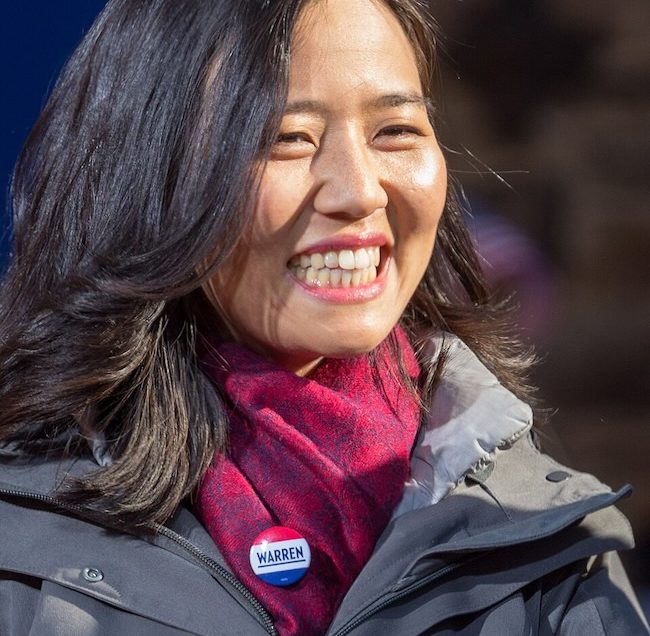
Michelle Wu became a diamond in politics under the kind of early pressure that causes some to collapse
INTRO:
“We are ready to become a Boston for everyone.”
This is a quote from Harvard graduate and Boston Mayor Michelle Wu. And that’s a bold statement for a city known for its tradition and Mayflower-age heritage. Boston is one of the 13 original colonies and had a checkered history when it comes to diversity.
Alone, this has made her stellar ascent in the regional political realm nothing short of extraordinary.
But anyone will tell you, that’s just who Michelle Wu is – extraordinary.
Not only did she graduate Cum Laude from Harvard, she became mayor at 36.
This is a time when many women are settling into their careers, even changing professional paths and embracing new roles. But not Michelle, she was putting herself squarely in the spotlight for questioning and criticism.
She has held on to her mayoral seat through an election cycle, ultimately running unopposed in 2025 after Josh Kraft, whose dad owns the New England Patriots, outspent her by multitudes yet still under-performed in the preliminary to Michelle Wu’s staggering 49-point lead.
He withdrew and no one else was close to receiving the minimum votes to be put on the ballot.
Winning feels good. Winning twice, is better.
Winning as a woman? Even sweeter.
We’ve taken some time away from politics here on Ladies & Legends, and I feel like it’s a good moment at the start of the Year of the Fire Horse to throw ourselves back into the kiln so-to-speak.
Let’s get smarter, tougher, and more ambitious.
HOST:
“Hello welcome to Ladies and Legends, the podcast where we explore the personal journeys of legendary women and business leaders of Asian and Asian American descent. I’m your host Juyun, and today’s story is about the spunky challenger who, through her candidacy has highlighted the changing demographics of even the most traditional American cities, Boston.
Quick note, Boston is around 10.4% Asian American, Massachusetts is around 8.3% Asian American. These numbers surprise a lot of people, but they really shouldn’t.
What do Asian Americans love? Education. And what does Massachusetts have? Universities, lots of them, including world-renowned MIT, Harvard, Wellesley, etc.
Also it should be noted that these figures do not include foreign Asian students, of whom there are many.
Boston was one of the colonies founded by Puritan settlers escaping political and religious persecution. However, ironically and somewhat tragically, in more recent years Boston has been the site of known systemic disparities related to racial profiling, de facto segregation in schools due to policies like red lining, and other unsavory practices.
In fact as recently as 2023, Massachusetts ranked second in the nation for white nationalist propaganda activity. Texas ranked first according to the Anti-Defamation League.
This all sets the stage for Michelle Wu’s historic mayoral race and the success she’s seen as a policy and changemaker in office.
Her administration produced more affordable housing and new home owners in three years than any comparable period since 1998. She also advanced Boston municipal’s Green New Deal, launching programs like geothermal energy networks, fossil-fuel restrictions in buildings, and divested city investments tied to fossil fuels and prisons.
This is just a small sampling of her tremendous accomplishments.
She’s the emblem of grace under fire and belief in better.
And she gets things done, so let’s get into it.
PART 1: Early Life & Identity
Michelle Wu was born in Chicago on a cold January day. The 14th to be exact in 1985.
She is a Wood Rat which are known for being smart, resourceful, versatile. And the element of wood brings her a certain steadiness and creativity.
Her parents were immigrants from Taiwan. And their parents before them, were immigrants from mainland China. Her childhood wasn’t marked by political ambition. Just the opposite in fact, it was marked by political avoidance due to their own history of escaping civil war and corruption.
She has said:
“We never discussed politics at the dinner table, barely talked about current events. I realized later this was an intentional decision by my parents.” (Commonwealth Beacon)
Her father was admitted to the Illinois Institute of Technology for graduate studies however due to limited English proficiency, Wu ended up being the de facto translator.
Wu is the oldest of 4 children and in high school was a gifted student earning perfect ACT and SAT scores and was selected as a Presidential Scholar from Illinois.
For context this is considered one of the nation’s highest honors for high school students. In the whole country, only 161 eligible high school seniors are selected.
Her parents separated when she was in high school. Her father moved away, and this left Wu to care for her two younger sisters and mother. They would ultimately divorce. Her mom would descend into severe mental illness and Wu would move back to Chicago, a Harvard grad, to care for her family.
It was during this time of having to translate documents, navigate systems her family couldn’t fully access, that she came to the conclusion that political avoidance wasn’t a sustainable life tactic. She opened a tea shop to help her family stay afloat before ultimately moving back to Cambridge, family in tow, to attend Harvard Law School.
“The systems we had to interact with weren’t designed for people like my family,” she said.
Even during her undergrad years, on the weekends while her classmates stayed close to Cambridge or visited home, she would take the Red Line over the Charles River to Boston to teach classes to seniors in Chinatown looking to become naturalized citizens.
“And that was my home,” Wu says. “That was my home away from home. That feeling of being surrounded by amazing people who had given up so much to come to this country for their families, and I’m getting to help them a little bit in navigating a very important part of their life.”
After the classes she taught some of her students would ask her for help understanding things like overdo utility bills.
She has said of this “ah-ha” moment:
“It’s all connected when you realize there are so many resources around, the services are there, the point of our government in such a well-resourced city is to provide that support and yet the disconnect when people most need that help is huge.”
So the summer before Wu started at Harvard Law School (that’s right she’s a double Harvard Alum), she worked at a legal services clinic in Jamaica Plain. She also decided to learn Spanish based on the large population base there.
——
PART 2: From Harvard Law School to Purpose
At Harvard Law School, Michelle Wu studied under Elizabeth Warren.
Warren’s focus on structural fairness — how systems shape opportunity — deeply influenced Wu’s thinking. Though that’s not to say her initial aim was politics. It wasn’t.
She worked in civil rights advocacy and consumer protection, because what interested her, was fixing systems. And this was the orientation shaped her entry into Boston politics.
When she ran for City Council in 2013, she didn’t campaign as a personality.
She campaigned as a planner. Her talking points were transit equity, housing production, and climate resilience. In a city known for personality-driven politics, this was unusual.
But it worked.
Boston, like many cities, was beginning to feel the strain of inequality, housing costs, and infrastructure aging.
She has said:
“What we need to just connect all the dots is leadership that has that sense of bold aspiration, urgent action, and community-based vision.” (Commonwealth Beacon)
So in 2013 the top four elected earned a seat in the City Council. Michelle Wu came in 2nd. In 2015, she came in second again. In 2017 and 2019, she came in first. After that she decided not to seek a fifth term, and instead run for mayor.
Some of her accomplishments on City Council include:
A paid parental leave ordinance that provided city employees with six weeks of paid parental leave after childbirth, stillbirth, or adoption.
Wu authored this plan and Mayor Marty Walsh supported Wu’s ordinance prior to its adoption, and signed it into law in May.
She also put forth a resolution with fellow councilor Matt O’Malley to have the city adopt Community Choice Aggregation, an alternative to the investor-owned utility energy supply system. Basically, the CCA chooses the power generation source on behalf of the consumers and with a bigger negotiating power than individuals alone have, can secure better rates.
You know those re-usable bags we love so much? In Boston you have Wu to thank for that.
Wu was the one with her fellow councilor O’Malley, to implement the plastic bag ban. This was something the mayor had formerly opposed, but ultimately signed into law.
Honestly I could go on and on about Wu’s accomplishments in City Council, but then I’d just be bragging way too much, and we don’t have time for that here.
Suffice to say, her feats in the areas specifically of free public transport which gained some headway, housing, seeking to stabilize prices and increase citizen home ownership rather than investor ownership for short term rentals, and environmental and law enforcement matters, were impressive for a policymaker at any age, but especially one so young.
PART 3: Personal Life
Before we get into her first mayoral race, I want to talk a little bit about what was going on behind the scenes in Wu’s personal life.
If anyone deserves a happy ending it’s Michelle Wu.
And she by all accounts has found it.
Wu is married to Conor Pewarski, a man she met when she was playing hostess for a post-Yale-Harvard game soiree. He came through mutual friends and the rest as they say, is history. He finished up school at Yale and they dated long distance before moving to be with her.
They married in 2012 and have three children.
Pewarski himself also comes from a big brood as the oldest of five siblings.
Perhaps the most important part of his dossier is that Pewarski has been extremely supportive of Wu’s work and ambitions. While sources mention his prior work in banking, he has since left that field.
He’s said:
“I don’t see myself as giving up my career altogether. But it’s hard to say that there’s a more important job than what my wife is doing. So, really, my primary job right now is making her successful at that.” (The Boston Globe)
In this era of individual achievement, it’s nice to see a spouse so supportive of his wife, so kudos to Mr. Pewarski and we’re all happy to hear that Michelle Wu has a helpful partner that allows her to reach for the stars when it comes to bridging equality gaps and policy change for the citizens of Boston.
PART 4: The Mayoral Race & Stars Align
So this brings us to Wu’s first mayoral run in 2021.
At the time the whispers were that she would be running against incumbent Marty Walsh another Democrat who served as mayor since 2014. And that would have been something because he is widely regarded as an incredibly popular public figure, maintaining a favorability rating reaching 70% among voters in 2020.
But this tells us even more about Wu – she’s not afraid of a little challenge.
But sometimes stars align.
As fate would have it, the Biden administration nominated Walsh for the Secretary of Labor position. This lead to an open-seat election.
Just days later, Wu’s former law school contracts professor Elizabeth Warren, endorsed her for the position. Even in the nonpartisan primary she was the widely regarded frontrunner. When it came time for the general election, though she faced off against former City Council colleagues, she secured endorsements from the acting mayor, congresswoman Ayanna Pressley, and both of Massachusetts’ U.S. Senators.
As a familiar name with a progressive agenda, she won handily with 64% of the vote.
She was the first non-white person, and first woman to be elected.
I think this brings up something worth talking about.
Her rise to the top ranks of local politics certainly seemed meteoric.
But it wasn’t, was it?
It happened through the compounding of hard work, belief, collaboration – in my research many of the things she accomplished as City Council member, required her not only to push her agenda through, but to actually author the plans herself. And they all had clear direction – we’re building an economy of care and sustainability for people and for the environment.
And Michelle’s deep roots as the daughter of immigrants navigating a complex governmental system allowed her to empathize and understand a system that does not work for everyone or in fact most people except the privileged. And it gave her the conviction to take her hard-earned legal and intellectual skills to the task of fixing the system, so to speak.
The pressure that some people collapse under, is the same pressure that makes a diamond.
Sometimes all that work we do behind the scenes without getting apparent credit is exactly the thing that propels us light years forward at a future point.
Do the work, keep the faith, and keep it moving.
PART 5: In Office Accomplishments
For many voters, Wu represented a generational shift in leadership — away from transactional politics toward structural governance.
And the progressive agenda she ran on meant:
• Affordable housing
• Reliable transit
• Climate preparedness
• Neighborhood economic vitality
As mayor, Wu’s policies have reflected the same themes that defined her campaign.
Climate Action as Civic Survival
Boston faces rising seas and aging infrastructure. Wu’s approach treats climate as a governance issue, not a branding issue.
She declared a climate emergency and pushed Boston toward aggressive emissions reduction strategies.
Her administration has invested in building electrification, climate-resilient infrastructure, and long-term sustainability planning.
In fact, Boston is now seen as one of the most climate-forward cities in the U.S.
Housing as the Foundation of Equity
Wu has also focused heavily on housing production and tenant protections.
Her framing is clear:
Cities become inequitable not because of intention — but because of inaction. If housing doesn’t keep pace with growth, infrastructure and equity collapses.
Wu’s housing initiatives aim to prevent Boston from becoming a city only the wealthy can inhabit. And towards that goal Boston has started construction on 17,000+ housing units between 2022 and 2024.
And it was mentioned in the intro, but her administration produced more affordable housing and new homeowners in three years than any prior three-year period since 1998 pushed policies like rent stabilization proposals and programs to convert offices into housing to address shortages.
Transportation as Opportunity Access
Wu’s push for fare-free bus pilots reflects a broader philosophy, which is that transportation isn’t just mobility. It’s access.
To jobs.
To education.
To healthcare.
Wu’s approach reframed transit as social infrastructure and she launched fare-free bus pilots on several routes serving lower-income neighborhoods.
Schools and Public Services
She proposed major investments in school infrastructure tied to climate and equity goals. She also wants to increase attendance by addressing things like transportation reliability and participation in upwardly mobile AP programs.
Public Safety
During Michelle’s Wu’s mayoral tenure Boston recorded record low homicide and gun-violence levels which has made it one of the safest major U.S. cities. She also negotiated police contracts that introduced transparency and accountability reforms.
I want to say, it can be argued that accessibility to greater services and support for those in lower socioeconomic stratas and improved access to education, also contribute to lower crime.
Whatever the reason, probably a combination of many factors, this is impressive.
City Infrastructure and Homelessness Response
Improvements included rebuilding sidewalks, upgrading lighting, improving ADA access, and expanding 311 services. Her administration created multiple transitional housing sites and moved hundreds from encampments into services and shelter.
OUTRO:
Michelle Wu recently won re-election.
She remains an extremely popular mayor, with an approval rating of 61%.
To provide a balanced perspective I looked into what criticisms she faced and many of them stemmed from her management style.
She’s kind of bossy.
For instance, she has been criticized for acting with limited collaboration from community leaders when it comes to community improvement projects in their areas.
An example of this is choosing construction firms that weren’t selected through community recommendation.
She has also been criticized for providing police and law enforcement a list of her more aggressive detractors which some see as Nixonian level control.
And it was frowned upon when she reversed a stance to originally implement a partially elected school committee.
But no one’s perfect. And we all make concessions to move forward.
The sheer level of achievement under her stewardship deserves applause. And in the current climate where personality over substance gets rewarded in politics, Michelle Wu’s substance over show is refreshing.
That wraps up today’s episode of Ladies and Legends. Whether you respect her resilience or stand in awe of her certainty at such a young age, Wu’s drive and conviction to get things done cannot be denied.
I’ll leave you with this last quote:
“The success of Boston’s economy is intertwined with the health and well-being of every neighborhood.”
Thanks for listening. Be sure to follow the show, leave a review, and share this episode if you enjoyed it. I’m Juyun, and I’ll catch you next time on “Ladies and Legends.”

Leave A Reply